In modern engineering, material selection is one of the most critical decisions in any design process. The right material can enhance performance, extend service life, and reduce maintenance costs, while the wrong choice can lead to premature failure and costly redesigns. Among advanced engineering materials, oxide ceramics have earned a strong reputation for their exceptional thermal stability, chemical resistance, and electrical insulation properties.
From electronics and energy systems to medical equipment and industrial machinery, oxide ceramics play a vital role in applications where metals and polymers cannot meet demanding requirements. Yet, despite their widespread use, many engineers still find these materials challenging to select and design with effectively. Their brittle nature, specialized processing requirements, and sensitivity to design details require careful consideration.
This article provides practical guidance on oxide ceramics for engineers, focusing on material selection, design principles, manufacturing considerations, and real-world performance insights. Whether you are working on a new product or optimizing an existing system, this guide aims to help you make informed, confident decisions.
Understanding Oxide Ceramics in Engineering Applications
Oxide ceramics are inorganic, non-metallic materials composed primarily of metal oxides. Common examples include alumina, zirconia, and magnesia-based ceramics. These materials are produced through high-temperature processing that creates strong ionic and covalent bonds within a crystalline structure.
What distinguishes oxide ceramics from other engineering materials is their ability to maintain stability under extreme conditions. They resist oxidation, corrosion, and thermal degradation far better than most metals and polymers. As a result, they are often chosen for applications involving high temperatures, aggressive chemicals, or electrical insulation.
In engineering practice, oxide ceramics are valued not only for their inherent properties but also for their predictable behavior when properly processed. This reliability makes them suitable for precision components where consistent performance is essential.
Key Material Properties and Performance Characteristics
Mechanical Strength and Hardness
Oxide ceramics are known for high compressive strength and surface hardness. These properties make them resistant to wear, abrasion, and deformation under load. In sliding or contact applications, they often outperform metals and plastics.
However, tensile strength and fracture toughness are relatively low compared to ductile materials. This means oxide ceramics are strong under compression but vulnerable to cracking under tension or impact. Engineers must account for this behavior during design.
Thermal Stability and Heat Resistance
One of the most valuable features of oxide ceramics is their ability to retain structural integrity at high temperatures. Many grades remain stable well above the limits of conventional alloys.
Low thermal expansion and good thermal shock resistance in certain compositions allow components to withstand rapid temperature changes. This makes oxide ceramics suitable for furnaces, heat exchangers, and electronic substrates.
Electrical and Dielectric Properties
Oxide ceramics exhibit excellent electrical insulation and dielectric stability. These characteristics are essential in electronic packaging, sensors, and power systems.
Their resistance to electrical breakdown at high voltages supports reliable operation in demanding environments. Engineers often rely on oxide ceramics when designing high-frequency or high-power devices.
Chemical Resistance and Durability
Chemical inertness is another defining advantage. Oxide ceramics resist acids, alkalis, and solvents that degrade metals and polymers. This durability supports long service life in corrosive environments.
In chemical processing and biomedical applications, this resistance contributes to safety and reliability.
Selecting the Right Oxide Ceramic Material
Matching Material Properties to Application Needs
Effective material selection begins with understanding functional requirements. Engineers must evaluate operating temperature, mechanical loads, electrical demands, and environmental exposure.
For high-temperature insulation, alumina-based ceramics may be suitable. For applications requiring enhanced toughness, zirconia-reinforced compositions are often preferred. Each material family offers a different balance of strength, conductivity, and stability.
Selection should always be driven by performance needs rather than cost alone. Choosing a marginally cheaper material that fails prematurely often results in higher long-term expenses.
Purity, Grain Size, and Microstructure Considerations
Material purity significantly influences performance. Impurities can reduce electrical insulation, weaken mechanical strength, and compromise chemical resistance.
Grain size and microstructure also affect fracture behavior and thermal properties. Fine-grained ceramics typically offer better strength and reliability, while coarse grains may increase susceptibility to cracking.
Understanding these internal characteristics helps engineers predict real-world behavior more accurately.
Balancing Performance and Manufacturability
Not all oxide ceramics are equally easy to manufacture. Some compositions require complex sintering cycles or specialized tooling.
When selecting materials, engineers should consider production feasibility alongside performance. Collaboration with material suppliers and manufacturers helps ensure that chosen materials can be produced consistently at scale.
Design Principles for Oxide Ceramic Components
Managing Brittleness Through Geometry
Brittleness is the most significant design challenge associated with oxide ceramics. Unlike metals, they do not yield plastically before failure. Cracks can propagate rapidly once initiated.
Designs should minimize stress concentrations by avoiding sharp corners, thin sections, and abrupt transitions. Rounded edges, smooth surfaces, and uniform thickness improve reliability.
By distributing stress evenly, engineers can significantly reduce fracture risk.
Load Distribution and Support Structures
Oxide ceramics perform best under compressive loading. Designs should aim to place components primarily in compression whenever possible.
Proper support structures and mounting methods help prevent bending and tensile stresses. In assemblies, compliant layers or cushioning materials may be used to accommodate differential expansion.
This system-level approach enhances overall durability.
Tolerances and Dimensional Stability
Ceramic components often require tight dimensional tolerances. However, machining ceramics after sintering is challenging and expensive.
Designs should account for shrinkage during firing and allow for near-net-shape manufacturing. Working closely with manufacturers during the design phase helps achieve accurate dimensions without excessive post-processing.
Manufacturing and Processing Considerations
Powder Preparation and Forming Methods
The performance of oxide ceramics begins with powder quality. Particle size distribution, purity, and homogeneity influence final properties.
Common forming methods include pressing, extrusion, and injection molding. Each technique affects density and microstructure, impacting strength and reliability.
Selecting the appropriate forming process is essential for consistent production.
Sintering and Densification
Sintering transforms compacted powders into dense ceramic bodies. Temperature, time, and atmosphere must be carefully controlled to achieve optimal density.
Incomplete sintering leads to porosity, which reduces mechanical strength and electrical insulation. Over-sintering may cause grain growth and reduced toughness.
Process optimization ensures balanced performance.
Finishing and Surface Treatment
Surface finish influences wear resistance, strength, and sealing performance. Polishing reduces surface defects that can act as crack initiators.
In some applications, coatings or surface treatments enhance compatibility with other materials. These steps must be carefully managed to avoid introducing residual stresses.
Practical Applications and Engineering Case Insights
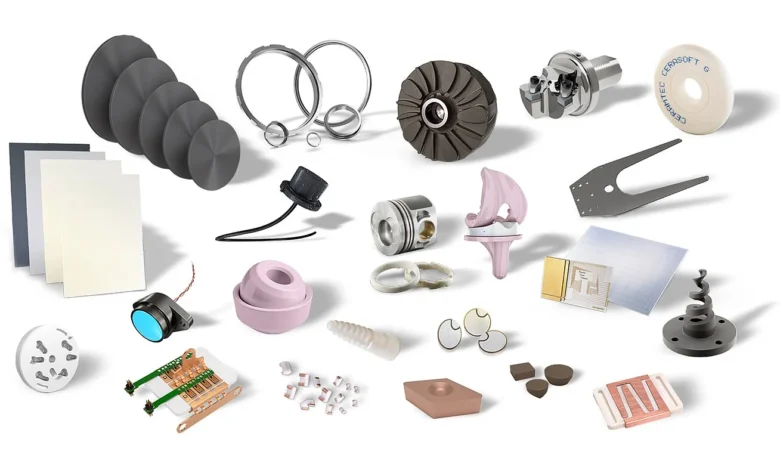
In electronic substrates, oxide ceramics provide thermal management and electrical isolation. Their stability supports reliable operation in compact, high-power devices.
In mechanical seals and wear components, hardness and chemical resistance reduce maintenance requirements. These parts often outperform metal alternatives in abrasive environments.
Medical devices use oxide ceramics for implants and instruments due to biocompatibility and sterilization resistance. Consistent material behavior is critical for patient safety.
Energy systems rely on oxide ceramics in fuel cells, sensors, and insulation components. Their long-term stability supports efficiency and durability.
These examples illustrate how proper selection and design translate material properties into real-world value.
Common Challenges and How to Address Them
Preventing Crack Initiation and Propagation
Surface flaws and internal defects are common sources of failure. Strict quality control and proper handling reduce these risks.
Designing with safety factors and conducting reliability testing further enhances confidence.
Joining and Assembly Difficulties
Joining oxide ceramics to metals or polymers is challenging due to thermal expansion differences. Brazing, adhesives, and mechanical fastening are commonly used solutions.
Each method requires careful evaluation to avoid introducing stress concentrations.
Cost Management
Advanced ceramics can be expensive, particularly in low-volume production. Engineers should consider lifecycle costs rather than initial price.
Longer service life and reduced maintenance often justify higher upfront investment.
Future Trends in Oxide Ceramic Engineering
Ongoing research is improving fracture toughness, processing efficiency, and functional integration. Nanostructured ceramics and composite systems are expanding performance limits.
Additive manufacturing techniques are beginning to influence ceramic production, enabling complex geometries and rapid prototyping.
Digital modeling and simulation tools are enhancing design accuracy, reducing development cycles, and improving reliability predictions.
These trends will further strengthen the role of oxide ceramics in advanced engineering systems.
Frequently Asked Questions About Oxide Ceramics
What are oxide ceramics used for in engineering?
Oxide ceramics are used in electronics, medical devices, energy systems, wear components, and high-temperature insulation due to their stability and durability.
Are oxide ceramics stronger than metals?
They are harder and stronger in compression but weaker in tension and impact compared to most metals.
Can oxide ceramics be machined easily?
Machining is difficult after sintering and usually requires diamond tools. Near-net-shape manufacturing is preferred.
How long do oxide ceramic components last?
With proper design and application, they can last for many years, often outperforming traditional materials.
Are oxide ceramics environmentally safe?
They are generally inert and stable, making them safe for many applications, including medical use.
What is the main limitation of oxide ceramics?
Brittleness is the primary limitation, requiring careful design and handling.
Conclusion
Oxide ceramics have become indispensable materials in modern engineering due to their exceptional thermal stability, chemical resistance, and electrical insulation properties. When selected and designed correctly, they offer performance levels that few other materials can match. However, their unique characteristics demand thoughtful material selection, precise design, and close collaboration with manufacturers.
By understanding microstructure, managing brittleness through geometry, and optimizing processing methods, engineers can unlock the full potential of oxide ceramics. Practical experience shows that attention to detail at every stage, from powder preparation to final assembly, is essential for long-term reliability.
As technologies continue to evolve, oxide ceramics will remain at the forefront of advanced material solutions. For engineers seeking durability, precision, and performance in demanding environments, mastering these materials is not just an advantage. It is a pathway to creating safer, more efficient, and more innovative engineering systems.